Baked doughnuts with discarded sourdough
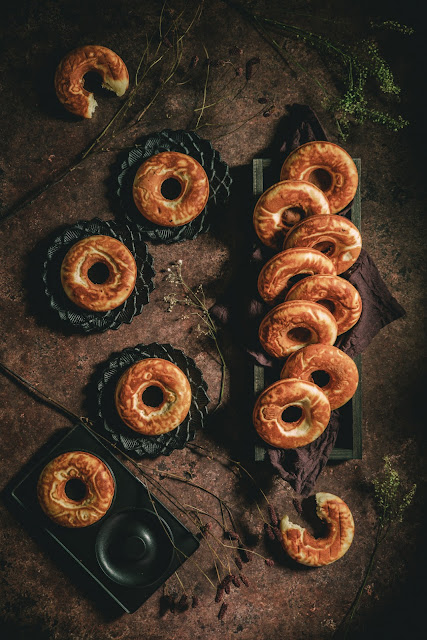
Baked doughnuts (version 3)
This is a version of dough where the rising agent is the baking powder. There is nothing wrong with baking powder, I do many cakes based on baking powder. The only thing that I do not like is that after baking, most of these cakes/sweets shrink a bit. It is the case for these doughnuts too.
Making doughnuts with this recipe has a big advantage: it is very quick! The baking takes time but the way I manage is to set an alarm every 3 minutes and 45 seconds and I take out the doughnuts and scoop another batch. During the baking, I do plenty of other things, like cleaning the kitchen or putting dishes on the cupboard so I do not waste too much time.
I like this version better than the ones I baked and published on my blog so far. (see Baked doughnuts and Baked doughnuts (version 2) )
There is however a version that I never tried before and tempts me so much.... wait for my next post.
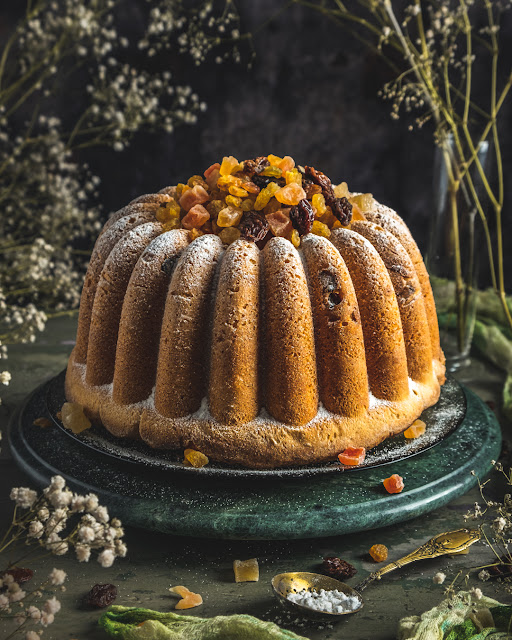
Sourdough kougelhopf
I've also had a quest in perfecting recipes based on baking powder but I found a few disadvantages that almost made me give up.
The first is the fact that all rely on the chemical reaction in the oven. There is no way to guess its behaviour in the oven only by looking at the dough before. Will it rise enough? Will it crack? Will it be soft inside? With sourdough, the dough is already well-risen when the dough is put into the oven and this gives a good prediction about what you'll gonna get.
The second thing that I do not like is that the baking powder-based cakes deflate slightly when taken out from the oven. This never happens visibly when the dough is based on sourdough.
There are disadvantages to baking with sourdough too: it takes time and you may get it sour! Unlike bread dough, where you need to perform a series of steps, this dough is mixed, let to rest for 30 minutes, and then left alone to rise overnight in a warm place. The used starter is not a liquid one but a stiff one. Although you can quickly transform a liquid starter into a stiff starter in only one step this is not enough. There is a reason why pasta made is used for sweet dough: it reduces acidity. Pasta made has its own preparation steps in order to get it right for the dough and this actually takes one day: start with a sourdough bath, to reduce the acids, then feed it 3 times at shorter intervals (kept at warm temperature) to get it very active.
This was my first trial to get it properly done (in line with the indications) and I did my best to align. The ph of the starter I did not get it right during the feeds, I'll need to tinker with some methods/temperatures to get it perfect next time.
Analysing the cake, here are my thoughts: the rise was good but I believe there is a place for better; the taste was interesting and nice but I detected a bit of sourness that shouldn't be there. The cause is still related to the power of the starter to rise the dough and temperature.
If you want to know the original recipe, I invite you to check the book "Coffret Traité de boulangerie au levain" by Thomas Teffri-Chambelland. I have the French version but I understood there is an English version too. Please note that this book is not for beginners... it's about the science of baking and there are a few recipes presented too. But if you are a sourdough geek, I can only recommend this book(s). No hidden publicity here, just my honest opinion as a homemaker with a passion.
I will test more recipes with sweet sourdough in the future although clearly not as often as I'll do for bread. For this recipe, I'd make a few more adjustments to make it perfect but I have to tell you that my kids loved it as such. Here is the recipe:
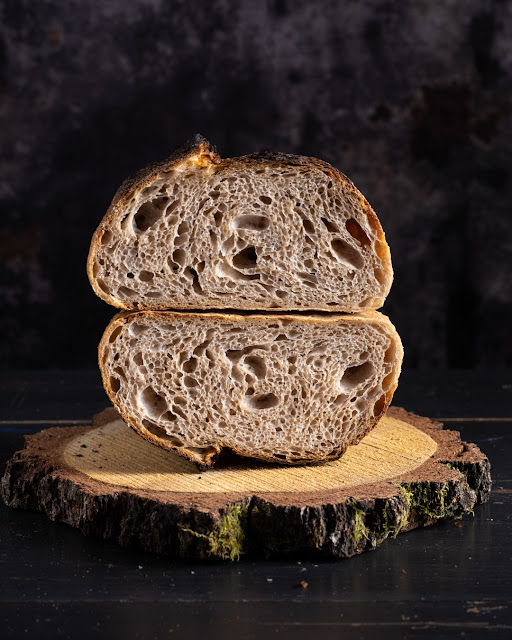
Whole Spelt Sourdough
I need to confess that I have a love-and-hate relationship with open-crumb sourdough bread. While I am super excited when I cut it and see these lovely big alveoli and feel proud that I managed to catch the fermentation just at the right moment, my excitement goes lower when I agree with my daughter saying "mommy, there are too many big holes in this slice for the butter to stay!" To this practicality issue, no argument that "it is the best fermented bread" and that "I mastered the process" does not stay up.
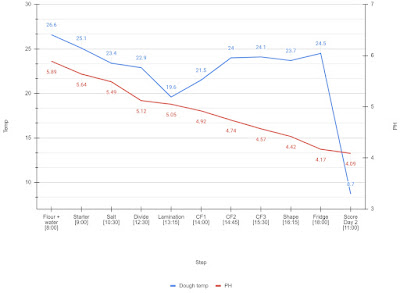
fold set 2 and 3. But I resisted, thinking... scientific measurement might be more precise than my eye. Even more, after shaping I kept the loaves in bannetons until reached the 4.2 level and just after, I put them in the fridge.
100% Semolina Sourdough Bread
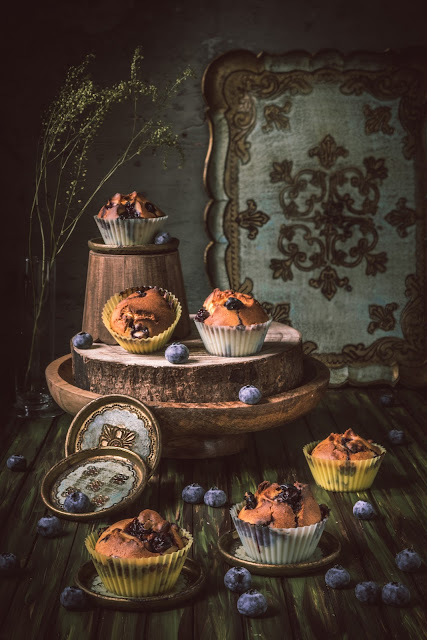
Blueberry muffins (version 2)
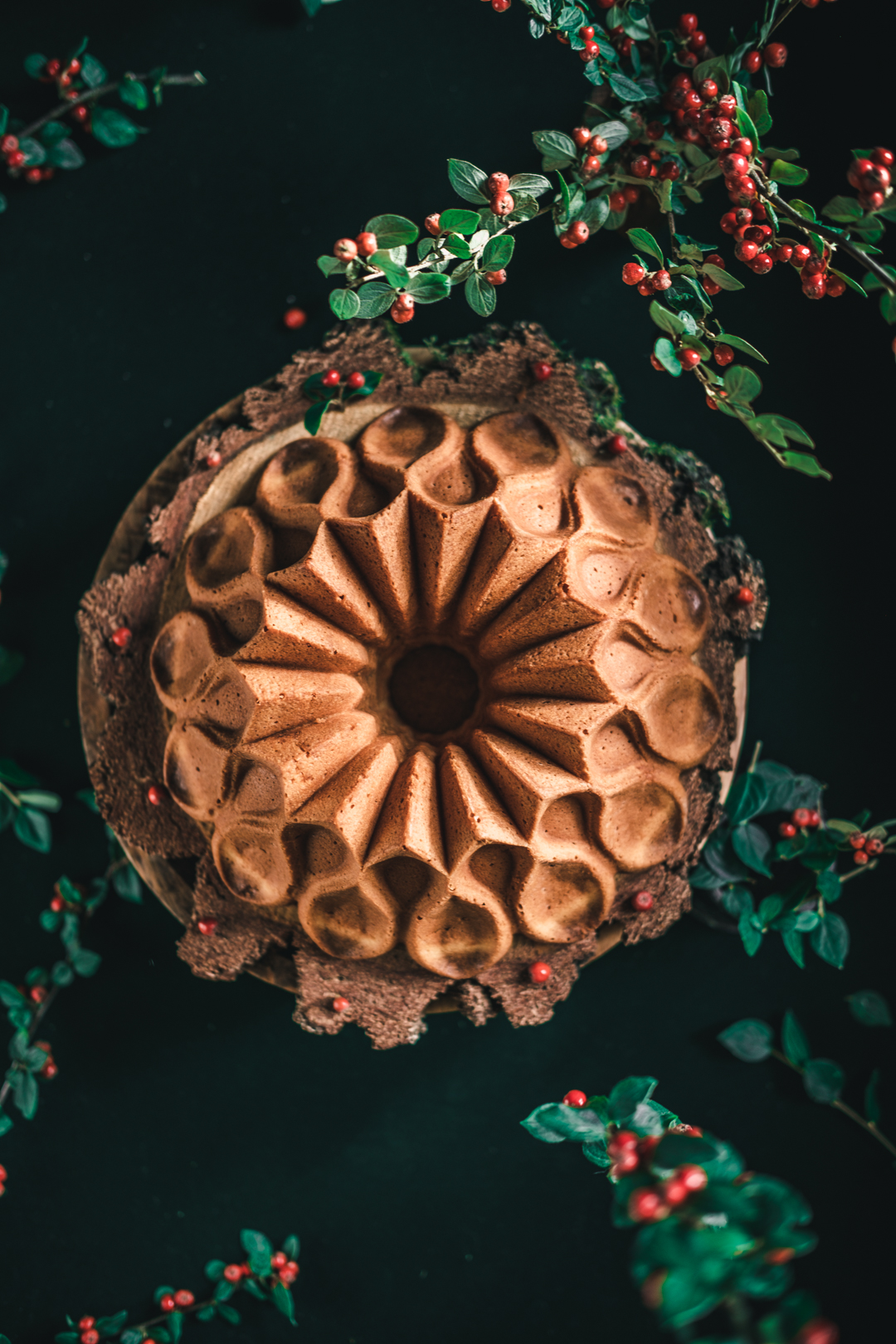
Coconut Bundt
I leave you to imagine the same and and a bit more... a bundt cake made with coconut.
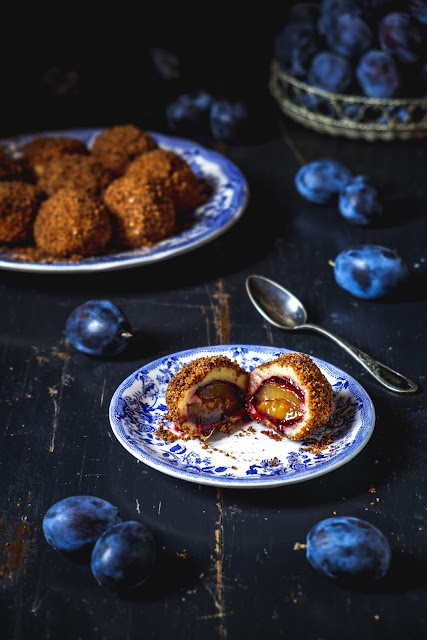
Plum Dumplings
Ingredients:
Dough:
- 550g boiled/steamed potatoes
- 150g all-purpose flour
- 80g sugar
- 2 yolks
- a pinch of salt
- 20 small plums
- 40g sugar
- 1 teaspoon cinnamon
- 150g breadcrumbs
- 60g butter
- 60g sugar
- 1 teaspoon cinnamon
- Prepare the plums by cutting them only on one side to remove the pits. You should not cut them in halves completely, the 2 parts need to stay together to maintain the integrity of the plum.
- Add over the sugar and cinnamon and stir the plums with your hand. Set aside.
- Prepare the coating by melting the butter in a pan and adding the bread crumbs.
- Toast the breadcrumbs on low heat and stir until the colour is a beautiful light golden brown.
- Turn off the heat and add the sugar and cinnamon, Set the pan aside and let's start the dough.
- For the potatoes, I prefer to peel them first and steam them. Smash or grate the potatoes (without peeling obviously if you chose the boiling option)
- Add over the sugar, yolks, flour and salt and mix. You should be able with all these ingredients to form a sticky dough using your hand. If it feels too wet, you may add one extra tablespoon of flour. It is not recommended to use a mixer at this stage to avoid gluten formation and because the dough will turn too elastic and very sticky.
- Portion the dough into 35g balls. This is the quantity needed to cover the plums.
- Dress each plum with the dough from a ball, sealing well the dough around. Repeat this for all the plums.
- Boil 2-3 litres of water in a pot and add 10 dressed plums using a slotted spoon.
- Let them boil on medium heat until they float, then remove them to a plate. Put the second batch of plum balls to boil in the pot while we are coating the first batch.
- Roll the hot dumplings in the toasted breadcrumbs until they are completely covered. Proceed in the same way with the remaining plums.
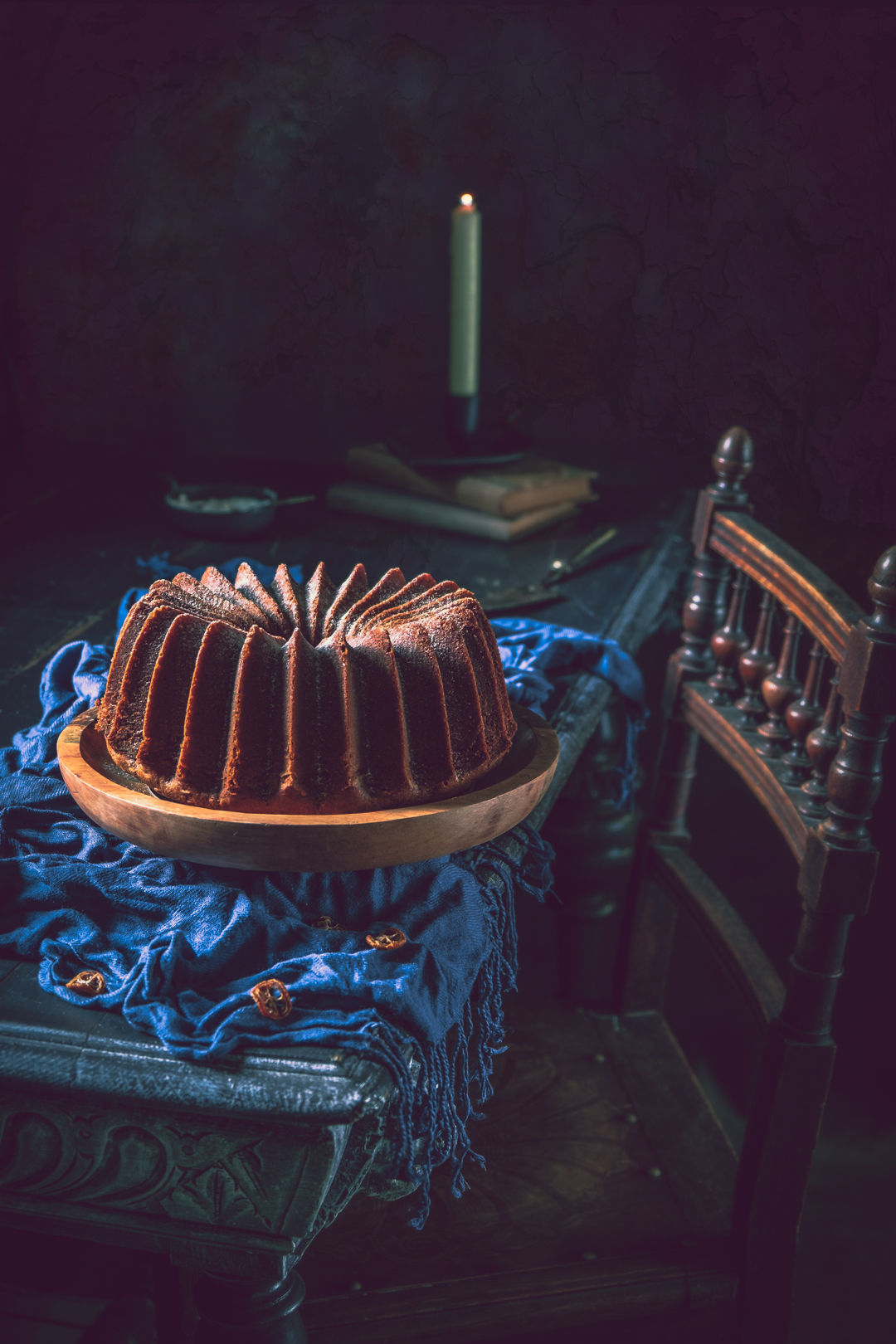
Lemon Bundt Cake
I made this cake recipe for the occasion of my daughter's birthday. To be sure it would be a successful cake, I did it 3 times. The first time was a catastrophe. If you recall, I have a bundt cake book that I love in terms of a combination of ingredients but it is way unbalanced when it comes to quantities. So, every cake is a real challenge. But I do not give up, because this is how I learn to adjust the recipes. The more I fail, the more I search for the mistake and I fix it with the next bake. This is how I grow my experience with baking.
The first one rose nicely in the oven but when cooling it fell down to a level lower than before the baking. I've learned 3 lessons: first, the butter needs to be at room temperature when I bake this type of cake, second, never trust the timing mentioned in the recipe book and third, if you feel there is not enough flour to make a consistent batter, simply add it. My cake was undercooked in the middle and overcooked on the crust. The combination of those factors led to the cake falling down.
The second bake was a control bake and is the one you see in the photo. It turned out with a great crumb, exactly as I wished for. The third one was the cake that my daughter brought to school for her birthday and went exactly like the second one.
I learned my lessons and I've put another brick in my baking experience.
50% Semolina Sourdough Bread
To make fantastic sourdough bread with any kind of flour you need to understand its characteristics.
Semolina (or semola rimacinata di grano duro) is made from hard wheat not from the common wheat usually used for bread flour. Semolina is very popular for making pasta, couscous, and porridge but it can be successfully used in bread as well.
Semolina has a coarser texture than classical flour but should not be confused with rice or corn semolina. Semolina comes from durum triticum wheat and when ground in a coarser texture is called semola rimacinata. If it is further ground to a very fine texture, it is called durum flour.
Besides its texture, semolina has a pale yellow colour, has a more earthy aroma and it is rich in proteins but forms a low-quality gluten. This makes the dough less extensible and affects its structure.
However, there are some tricks that you can apply to overcome this issue.
- First, you can improve the structure by adding strong bread flour into its composition and this is exactly what we'll do today.
- Then, you can make a longer autolyse of 2-3 hours to develop the gluten to its maximum potential.
- or you can increase the mixing time too for the same goal.
I invite you to watch the video of this bread to learn more tricks about it.